Ubuntu TechHive

The Ubuntu TechHive North America

Atlanta , Georgia, USA

The Ubuntu TechHive is a community of African technology professionals who are committed to collaboration, innovation, and progress. Our members are software engineers, data scientists, web developers, machine learning experts, and more, and we come from all across the African continent.

We believe that by working together and sharing our skills and knowledge, we can create powerful solutions to the challenges facing our communities. Our focus is on building a strong network of professionals who are dedicated to using technology to drive progress and development in Africa.

Through regular meetups, workshops, and other events, we share knowledge, collaborate on projects, and foster a sense of community and connection. Whether you're an experienced technology professional or just starting out, we welcome you to join our community and help us build a better future for Africa.

Group Events

View All Events
PastThe Ubuntu TechHive North America Online

Building Your Own Agent Experience with Pi

A practical two-hour exploration of how developers can move beyond the fixed behavior and interfaces of conventional coding assistants and create agent experiences tailored to their own tools, workflows, and applications. Using Pi as the implementation context, we will examine how a small agent core can be extended with new capabilities, interactive interfaces, custom workflows, and programmatic behavior without requiring a large agent framework. We will also explore what happens when that agent is no longer tied to one terminal session: when work can persist, resume after interruption, be observed from different interfaces, or become part of a shared application. The emphasis is on the underlying ideas that make an agent adaptable: extensibility, composition, embedding, state, and durability. Audience: developers at any level who use AI coding tools and want to understand how those tools can become programmable building blocks rather than fixed products. Outcomes: Understand how an agent can expose its behavior as an extensible software surface Explore custom tools, interactions, and workflows See how agent functionality can be embedded into another application Understand programmatic composition of agent tools and capabilities Explore persistent conversations and resumable agent work Understand the possibilities created by shared and multi-interface agent sessions Identify practical situations where a lightweight programmable agent can replace a more rigid workflow Format: two hours with a fast conceptual walkthrough, compact demonstrations, an interactive end-to-end example, discussion, and questions and answers.

Atlanta, Georgia, USA · November 14, 2026 · 10:30 AM · EST · 2 hours

PastThe Ubuntu TechHive North America Online

From JavaScript Runtimes to Durable Compute

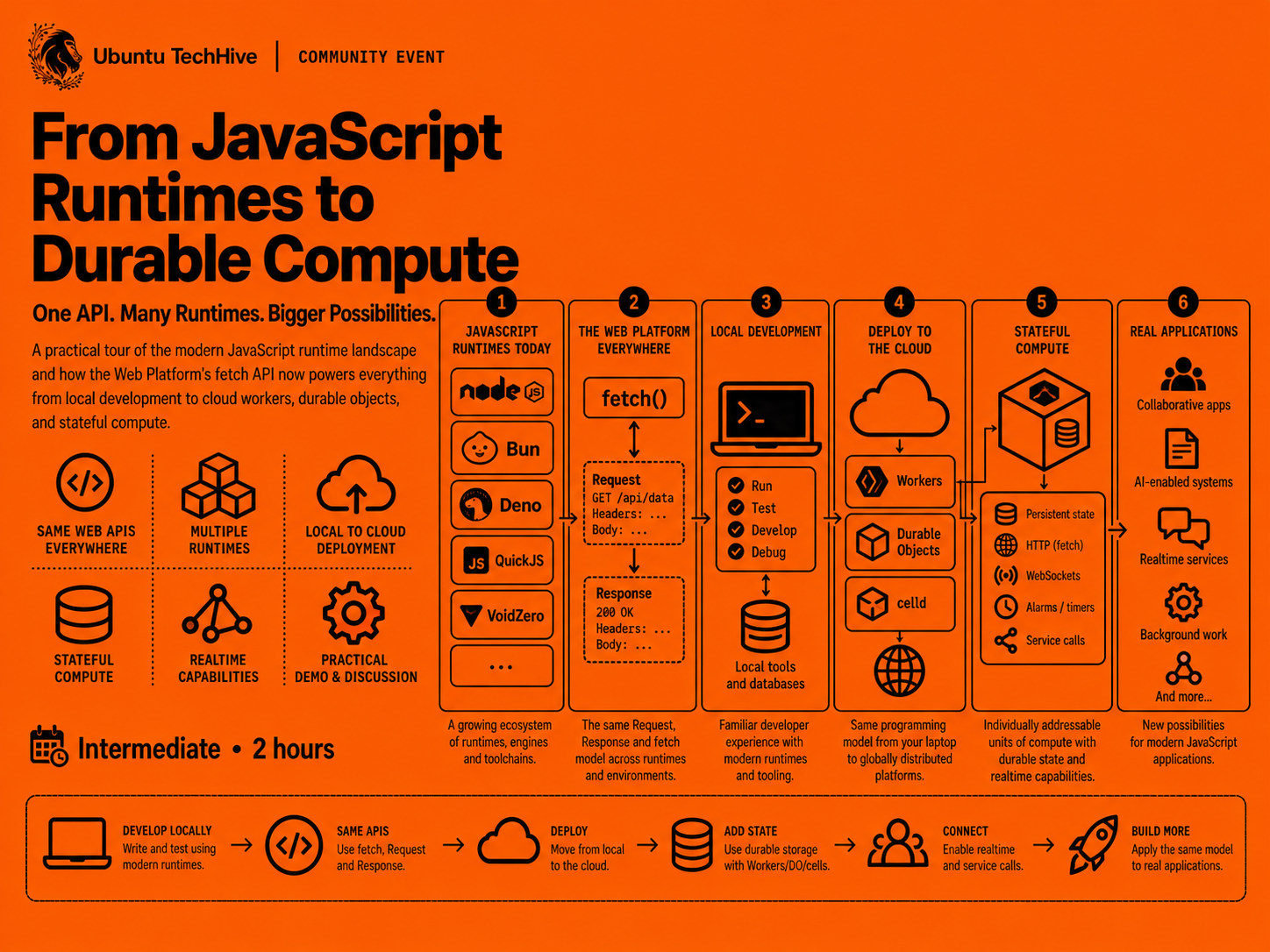
# From JavaScript Runtimes to Durable Compute A practical two-hour tour of how JavaScript execution has evolved from traditional local runtimes into a broader computing platform spanning development machines, servers, cloud workers, and durable stateful applications. The session explores the changing role of JavaScript runtimes and the growing importance of Web Platform APIs as a common programming model across environments. We will look at how familiar concepts such as requests, responses, asynchronous I/O, and `fetch` now connect everything from ordinary API calls and web servers to cloud execution and increasingly sophisticated stateful computing models. From there, we will explore one of the more interesting shifts happening in server-side development: moving beyond stateless request handlers toward individually addressable units of computation that can own persistent state, communicate with other services, and survive beyond a single request or process. Rather than comparing runtimes feature by feature, the goal is to develop a useful mental model for how the JavaScript ecosystem is changing, what is becoming portable across environments, and how these changes affect the way modern applications can be designed. Audience: developers and learners interested in JavaScript, backend development, cloud computing, or modern application architecture. No prior experience with alternative runtimes or distributed systems is required. Outcomes: - Understand how the role of the JavaScript runtime has expanded beyond the traditional server process - Recognize Web Platform APIs as an increasingly common interface across local and cloud environments - See how the `Request`, `Response`, and `fetch` model connects client, server, and service-to-service communication - Distinguish stateless request processing from durable stateful computation - Understand the basic idea behind addressable units of compute that own their own persistent state - Explore how these models affect realtime applications, collaboration, AI-enabled systems, and other stateful workloads - Develop a clearer framework for evaluating new JavaScript runtimes and computing platforms as the ecosystem continues to evolve Format: two hours with a concise tour of the changing JavaScript runtime landscape, progressively deeper examples, a focused live demonstration of stateful compute, discussion of architectural tradeoffs, and questions and answers.

Atlanta, Georgia, USA · October 31, 2026 · 10:30 AM · EDT · 2 hours

PastThe Ubuntu TechHive North America Online

Your Codebase, Your Rules: Beyond Standard Linters

A practical two-hour session on turning code quality expectations and team conventions into automated checks so developers and coding agents get feedback on what belongs in your codebase, not just what compiles. Code can run correctly and still break your team’s rules: too many branches in one function, business logic in the wrong directory, or calls that bypass an approved API. Through small working demos, we will make these violations visible, adjust complexity thresholds, and implement conventions that no standard linter knows about. The emphasis is on making your expectations executable. Instead of repeating a convention in every prompt or code review, we will express it as a check that identifies violations and provides concrete feedback for correcting them. We will also distinguish likely bugs from team preferences, and explore why passing every check does not automatically mean good design. Audience: developers, technical leads, and architects interested in keeping codebases consistent as human and AI-generated contributions grow. No prior experience writing custom checks is required. Outcomes: * Distinguish correctness checks, complexity measurements, and team-defined conventions * Configure a complexity threshold and observe its effect on otherwise unchanged code * Implement custom rules about where particular functions and dependencies belong * Enforce application-specific naming conventions beyond a tool’s built-in defaults * Understand when inspecting syntax is sufficient and when deeper analysis is needed * Give developers and coding agents actionable feedback rather than repeated reminders * Recognize what automated checks can enforce—and what still requires judgment Format: two hours with a short introduction, small working demonstrations, deliberate rule violations, discussion of tradeoffs, and questions and answers.

Atlanta, Georgia, USA · September 19, 2026 · 10:30 AM · EDT · 2 hours

PastThe Ubuntu TechHive North America Online

From Idea to Live Web App: Building with Humans and AI Agents on Buzz

## What to Expect AI assistants can help one person write code. The more interesting question is what happens when humans and AI agents work together on a real product, with the conversation, decisions, reviews, and work kept in one shared place. Join us for a beginner-friendly live build using Buzz, an open-source workspace designed for humans and AI agents to collaborate. We will start with a real but deliberately incomplete product brief, work through research, design, implementation, and review, and finish by deploying a working web application that you can open in your browser. The application will be revealed during the session. This gives the community room to follow the work as it develops, contribute ideas, and see how a small team can move from an uncertain starting point to a useful deployed result. The focus is not only the application itself, but the collaboration process that makes the build understandable, reviewable, and repeatable. No prior Buzz, Nostr, or AI-agent experience is required. You will be invited to join the Ubuntu TechHive Buzz community, follow the build channel, ask questions, inspect the human-and-agent work trail, and continue the conversation with supporting material after the event. ## What We’ll Build Together - Start from an incomplete product idea and clarify what is worth building. - Use Buzz as the shared room for human decisions, agent research, implementation, and review. - Turn the selected direction into a browser-based web application. - Deploy the result to a public URL during the session. - Test the deployed application and discuss what should happen next. The exact application, framework, and feature list will be revealed as the build unfolds. That is part of the event: the audience gets to see the product take shape instead of watching a finished demo with all of the uncertainty removed. ## Agenda - Introduction: From individual AI assistants to teams of humans and agents building together. - Getting oriented: What Buzz is, how to join the community, and how channels, identities, agents, and project history work. - The live build: Open the brief, explore the problem, delegate work, make design decisions, implement the web application, and review the result in Buzz. - Deployment: Publish the working application to a public web URL and test it live with the audience. - What happened behind the scenes: Trace the useful decisions, rejected ideas, agent contributions, and human approvals in the Buzz channel. - Keep building with us: Join the community, read the supporting article, try the deployed result, and suggest the next improvement. - Questions and answers: Discuss Buzz, agent collaboration, web development, open-source workflows, and the live build. ## Who Should Attend? - Developers and learners curious about AI-assisted web development. - People who use AI coding tools but want to understand collaboration with multiple agents and human teammates. - Open-source developers interested in building in public and self-hostable tools. - Community members who enjoy seeing real software take shape through a live demonstration. - Beginners who want to learn what Buzz is by watching it solve a concrete problem. ## What You’ll Learn - Explain what Buzz is without prior knowledge of the platform. - Understand how human and agent identities can share a project workspace while keeping authorship and responsibility clear. - See a practical workflow for turning an incomplete brief into a reviewed web application. - Recognize how channels, history, search, and agent identity support better collaboration. - Join the [Ubuntu TechHive community on Buzz](https://ubuntu-techhive.communities.buzz.xyz/invite/v2.ipzGEj2p4HjIwM07OxfhZ_D-5A_38st6LP231xwUT6c) and find the live build and community-projects channels. - Evaluate where this approach could be useful in your own projects.

Atlanta, Georgia, USA · August 8, 2026 · 2:30 PM · UTC · 2 hours

PastThe Ubuntu TechHive North America Online

Inside SQLx: How Rust Checks SQL Before Your Application Runs

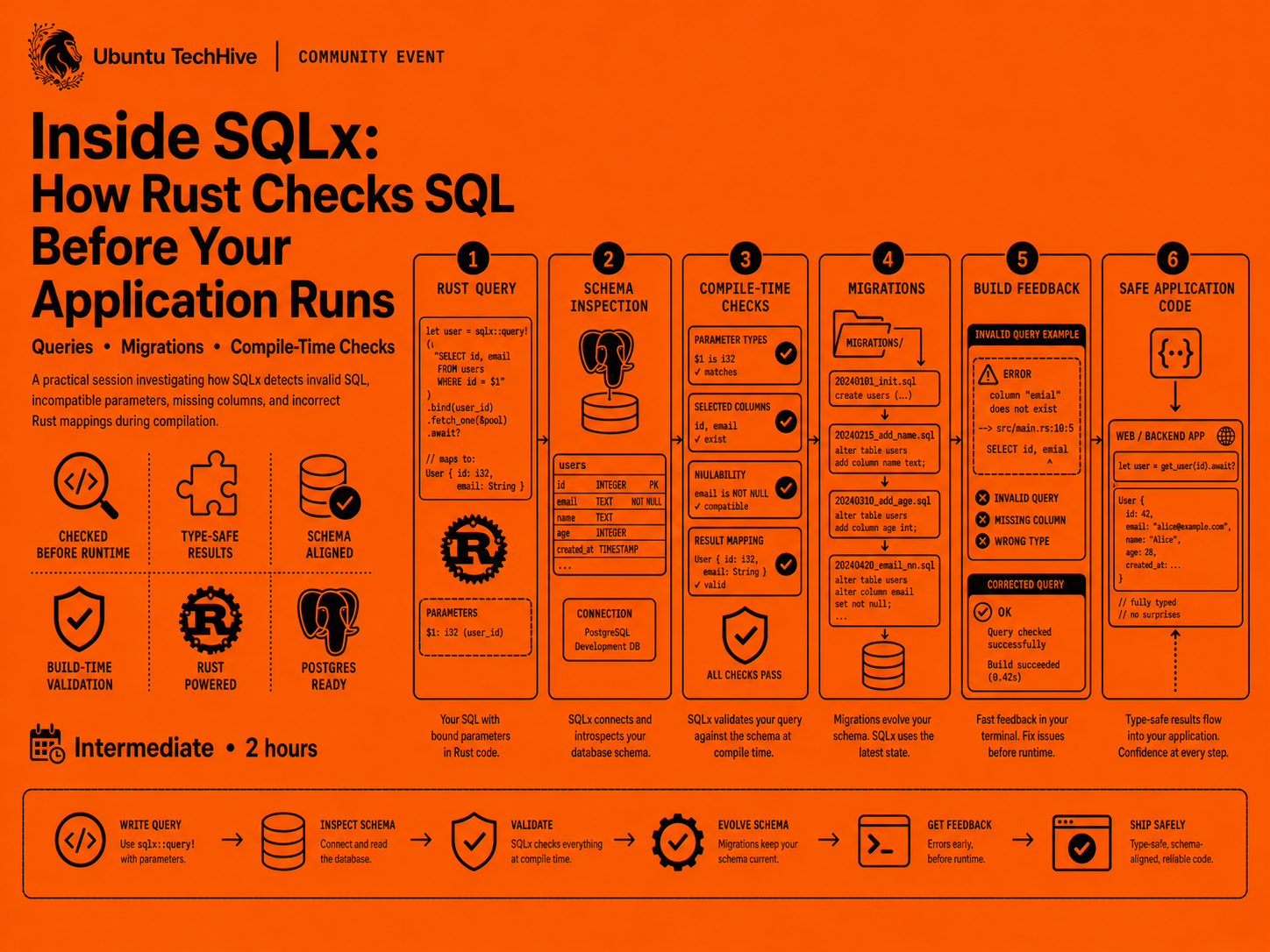
A practical two-hour session investigating how SQLx can detect invalid SQL, incompatible parameters, missing columns, and incorrect Rust mappings during compilation rather than after deployment. The session follows a query through the boundary between Rust and the database: from the SQL text and bound parameters, through schema inspection and type analysis, to the Rust value returned to the application. We will deliberately break queries, change schemas, and introduce type mismatches to understand what SQLx can prove before runtime—and what it cannot. The emphasis is not on memorizing an API. It is on understanding the engineering model behind compile-time checked SQL, the role of migrations in preserving that model, and the practical consequences for local development, testing, continuous integration, and deployment. Audience: developers who want to understand how Rust can provide stronger guarantees around ordinary SQL without replacing SQL with an ORM or query language. Outcomes: * Trace how SQLx validates a query during compilation * Understand how database metadata informs Rust type checking * See compile-time failures caused by invalid queries and incompatible result types * Understand why the current schema matters during a build * Connect database migrations to query correctness * Distinguish checked macros from runtime query APIs * Evaluate when compile-time SQL checking improves a project and when it adds friction Format: two hours with a guided investigation, broken-query experiments, migration examples, discussion of operational tradeoffs, and a reusable checklist for database code.

Atlanta, Georgia, USA · July 25, 2026 · 10:30 AM · EDT · 2 hours

PastThe Ubuntu TechHive North America Online

Building Document Question-Answering Systems with Rust

A practical two-hour session on the principles behind document question-answering systems, with Rust as the implementation context. The session focuses on how applications can answer questions from a known set of documents instead of relying only on what a language model already knows. We will cover the core workflow: loading documents, preparing them for search, finding relevant passages, passing useful context to a model, and producing answers that stay connected to the source material. The goal is to teach the engineering ideas behind RAG systems without turning the session into a product demo or an abstract AI lecture. The emphasis is on system boundaries, retrieval quality, answer grounding, error handling, and the practical decisions developers need to make when building document-aware applications. Audience: entry-level and intermediate developers who want a practical session on document search, retrieval, grounded generation, and Rust application design. Outcomes: * Understand how document-based question answering systems work * Explain the purpose of chunking, embeddings, retrieval, and context assembly * Design a simple retrieve-first, answer-second workflow * Use Rust to organize the main parts of a small RAG application * Recognize common causes of poor or unsupported answers * Apply basic techniques for improving retrieval and answer quality * Think about how to evaluate whether the system is actually useful Format: two hours with a short framing walkthrough, a concrete example, discussion of tradeoffs, and a closing checklist for practice.

Atlanta, Georgia, USA · July 11, 2026 · 10:30 AM · EDT · 2 hours