Ubuntu TechHive

// events

Tech Events & Workshops

Discover and join virtual tech events, workshops, and meetups from the Ubuntu community worldwide. Connect with developers, engineers, and tech enthusiasts.

0

Today

0

Upcoming

8

Virtual

8

Total

PastThe Ubuntu TechHive Online

From JavaScript Runtimes to Durable Compute

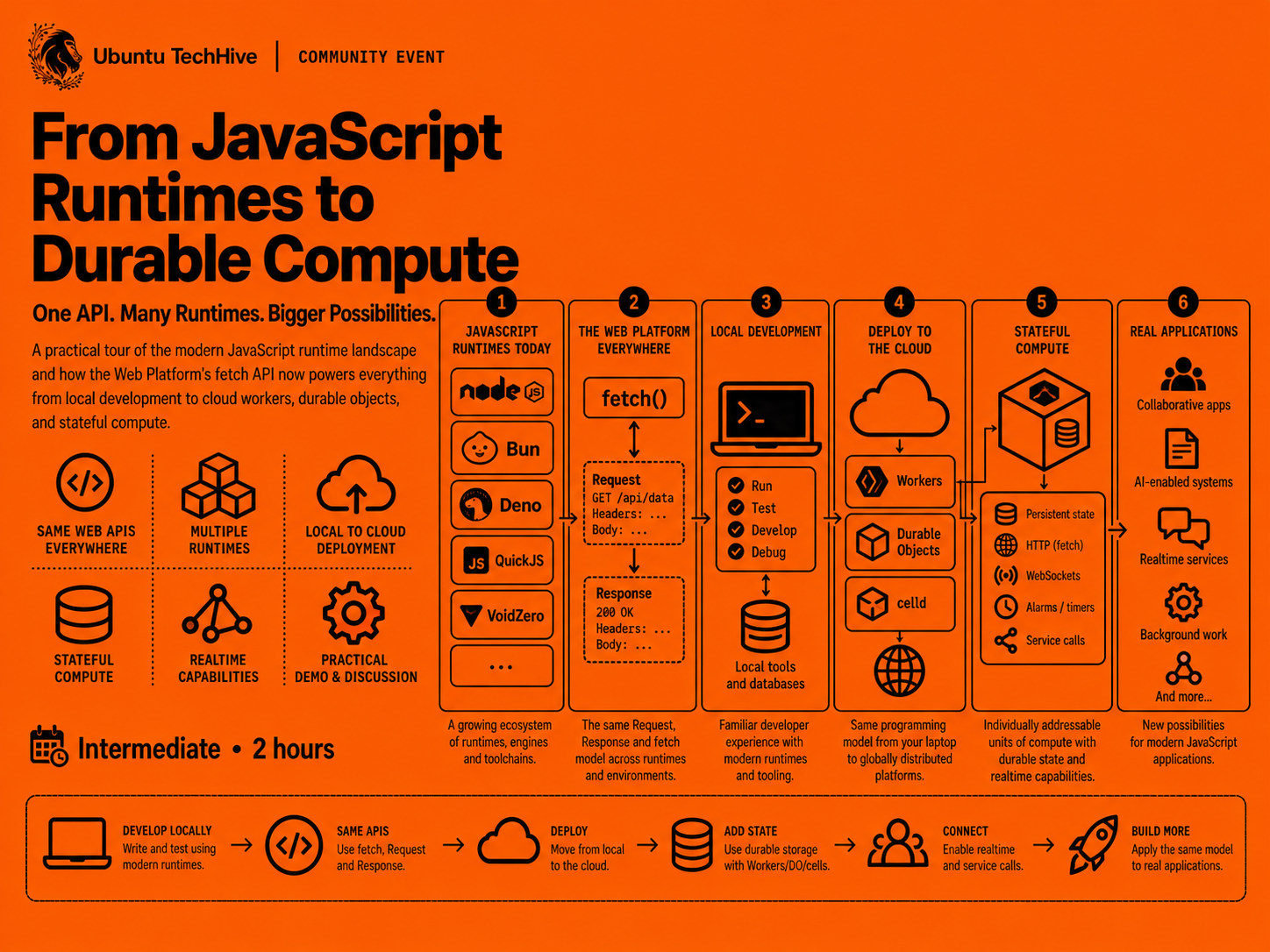
# From JavaScript Runtimes to Durable Compute A practical two-hour tour of how JavaScript execution has evolved from traditional local runtimes into a broader computing platform spanning development machines, servers, cloud workers, and durable stateful applications. The session explores the changing role of JavaScript runtimes and the growing importance of Web Platform APIs as a common programming model across environments. We will look at how familiar concepts such as requests, responses, asynchronous I/O, and `fetch` now connect everything from ordinary API calls and web servers to cloud execution and increasingly sophisticated stateful computing models. From there, we will explore one of the more interesting shifts happening in server-side development: moving beyond stateless request handlers toward individually addressable units of computation that can own persistent state, communicate with other services, and survive beyond a single request or process. Rather than comparing runtimes feature by feature, the goal is to develop a useful mental model for how the JavaScript ecosystem is changing, what is becoming portable across environments, and how these changes affect the way modern applications can be designed. Audience: developers and learners interested in JavaScript, backend development, cloud computing, or modern application architecture. No prior experience with alternative runtimes or distributed systems is required. Outcomes: - Understand how the role of the JavaScript runtime has expanded beyond the traditional server process - Recognize Web Platform APIs as an increasingly common interface across local and cloud environments - See how the `Request`, `Response`, and `fetch` model connects client, server, and service-to-service communication - Distinguish stateless request processing from durable stateful computation - Understand the basic idea behind addressable units of compute that own their own persistent state - Explore how these models affect realtime applications, collaboration, AI-enabled systems, and other stateful workloads - Develop a clearer framework for evaluating new JavaScript runtimes and computing platforms as the ecosystem continues to evolve Format: two hours with a concise tour of the changing JavaScript runtime landscape, progressively deeper examples, a focused live demonstration of stateful compute, discussion of architectural tradeoffs, and questions and answers.

Abidjan, Côte d'Ivoire · October 31, 2026 · 10:30 AM · EDT · 2 hours
PastThe Ubuntu TechHive North America Online

From JavaScript Runtimes to Durable Compute

# From JavaScript Runtimes to Durable Compute A practical two-hour tour of how JavaScript execution has evolved from traditional local runtimes into a broader computing platform spanning development machines, servers, cloud workers, and durable stateful applications. The session explores the changing role of JavaScript runtimes and the growing importance of Web Platform APIs as a common programming model across environments. We will look at how familiar concepts such as requests, responses, asynchronous I/O, and `fetch` now connect everything from ordinary API calls and web servers to cloud execution and increasingly sophisticated stateful computing models. From there, we will explore one of the more interesting shifts happening in server-side development: moving beyond stateless request handlers toward individually addressable units of computation that can own persistent state, communicate with other services, and survive beyond a single request or process. Rather than comparing runtimes feature by feature, the goal is to develop a useful mental model for how the JavaScript ecosystem is changing, what is becoming portable across environments, and how these changes affect the way modern applications can be designed. Audience: developers and learners interested in JavaScript, backend development, cloud computing, or modern application architecture. No prior experience with alternative runtimes or distributed systems is required. Outcomes: - Understand how the role of the JavaScript runtime has expanded beyond the traditional server process - Recognize Web Platform APIs as an increasingly common interface across local and cloud environments - See how the `Request`, `Response`, and `fetch` model connects client, server, and service-to-service communication - Distinguish stateless request processing from durable stateful computation - Understand the basic idea behind addressable units of compute that own their own persistent state - Explore how these models affect realtime applications, collaboration, AI-enabled systems, and other stateful workloads - Develop a clearer framework for evaluating new JavaScript runtimes and computing platforms as the ecosystem continues to evolve Format: two hours with a concise tour of the changing JavaScript runtime landscape, progressively deeper examples, a focused live demonstration of stateful compute, discussion of architectural tradeoffs, and questions and answers.

Atlanta, Georgia, USA · October 31, 2026 · 10:30 AM · EDT · 2 hours
PastThe Ubuntu TechHive North America Online

Inside SQLx: How Rust Checks SQL Before Your Application Runs

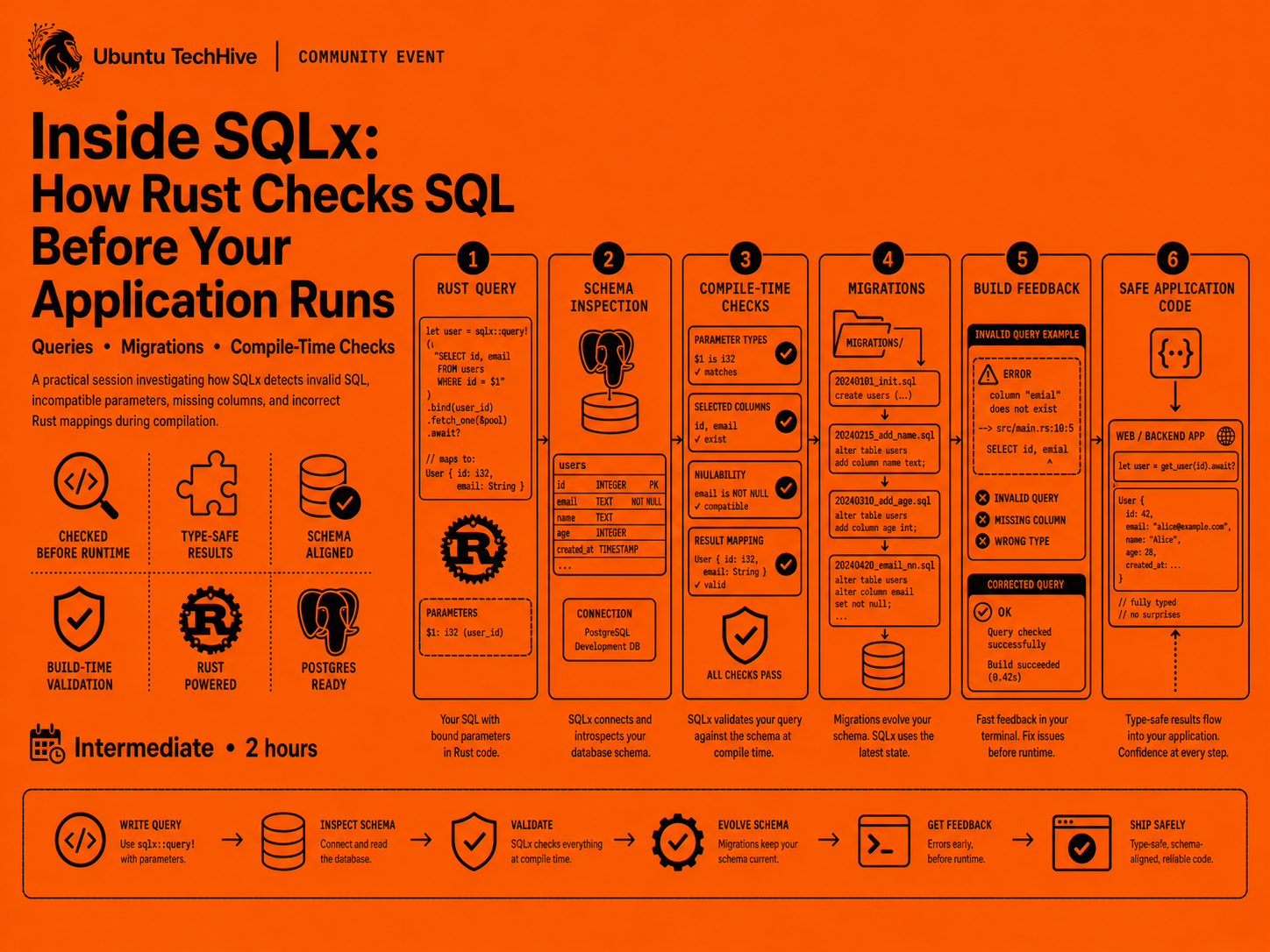
A practical two-hour session investigating how SQLx can detect invalid SQL, incompatible parameters, missing columns, and incorrect Rust mappings during compilation rather than after deployment. The session follows a query through the boundary between Rust and the database: from the SQL text and bound parameters, through schema inspection and type analysis, to the Rust value returned to the application. We will deliberately break queries, change schemas, and introduce type mismatches to understand what SQLx can prove before runtime—and what it cannot. The emphasis is not on memorizing an API. It is on understanding the engineering model behind compile-time checked SQL, the role of migrations in preserving that model, and the practical consequences for local development, testing, continuous integration, and deployment. Audience: developers who want to understand how Rust can provide stronger guarantees around ordinary SQL without replacing SQL with an ORM or query language. Outcomes: * Trace how SQLx validates a query during compilation * Understand how database metadata informs Rust type checking * See compile-time failures caused by invalid queries and incompatible result types * Understand why the current schema matters during a build * Connect database migrations to query correctness * Distinguish checked macros from runtime query APIs * Evaluate when compile-time SQL checking improves a project and when it adds friction Format: two hours with a guided investigation, broken-query experiments, migration examples, discussion of operational tradeoffs, and a reusable checklist for database code.

Atlanta, Georgia, USA · July 25, 2026 · 10:30 AM · EDT · 2 hours

PastThe Ubuntu TechHive Online

Inside SQLx: How Rust Checks SQL Before Your Application Runs

A practical two-hour session investigating how SQLx can detect invalid SQL, incompatible parameters, missing columns, and incorrect Rust mappings during compilation rather than after deployment. The session follows a query through the boundary between Rust and the database: from the SQL text and bound parameters, through schema inspection and type analysis, to the Rust value returned to the application. We will deliberately break queries, change schemas, and introduce type mismatches to understand what SQLx can prove before runtime—and what it cannot. The emphasis is not on memorizing an API. It is on understanding the engineering model behind compile-time checked SQL, the role of migrations in preserving that model, and the practical consequences for local development, testing, continuous integration, and deployment. Audience: developers who want to understand how Rust can provide stronger guarantees around ordinary SQL without replacing SQL with an ORM or query language. Outcomes: * Trace how SQLx validates a query during compilation * Understand how database metadata informs Rust type checking * See compile-time failures caused by invalid queries and incompatible result types * Understand why the current schema matters during a build * Connect database migrations to query correctness * Distinguish checked macros from runtime query APIs * Evaluate when compile-time SQL checking improves a project and when it adds friction Format: two hours with a guided investigation, broken-query experiments, migration examples, discussion of operational tradeoffs, and a reusable checklist for database code.

Abidjan, Côte d'Ivoire · July 25, 2026 · 10:30 AM · EDT · 2 hours

PastThe Ubuntu TechHive North America Online

DevOps in the Age of AI

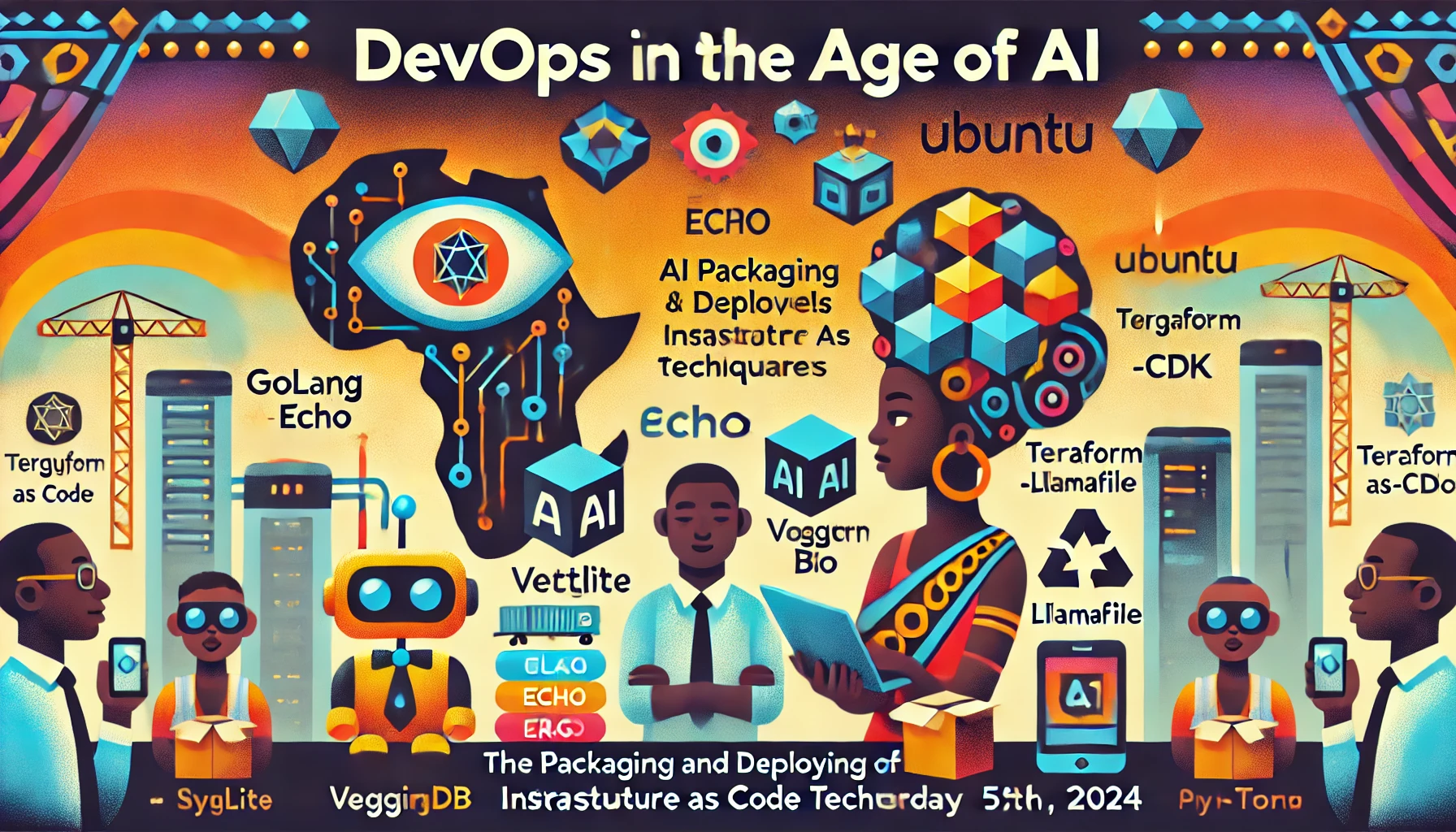
🚀 Join us for an exciting Ubuntu TechHive meetup where we'll delve into packaging and deploying AI models together with AI apps using Infrastructure as Code techniques and containers! Whether you're new to the field or looking to expand your knowledge, this beginner-friendly session is designed to walk you through the process step by step. 🎯 **Agenda**: - **Introduction**: Get acquainted with the concept of packaging and deploying AI models and apps. - **Manual Process**: Explore the manual process of packaging and deploying AI models and apps. - **Infrastructure as Code (IaC) Tooling**: Discover the use of IaC tooling for Continuous Integration and Continuous Delivery. - **Containerization**: Learn about containerization techniques for AI models and apps. 📍 **Who Should Attend?** - Beginners interested in packaging and deploying AI models and apps. - Tech enthusiasts looking to expand their knowledge in Infrastructure as Code and containerization. 👋 We look forward to seeing you there and exploring the exciting world of packaging and deploying AI models and apps together!

Atlanta, Georgia, USA · October 5, 2024 · 10:30 AM · EDT · 2 hours

PastThe Ubuntu TechHive Online

DevOps in the Age of AI

🚀 Join us for an exciting Ubuntu TechHive meetup where we'll delve into packaging and deploying AI models together with AI apps using Infrastructure as Code techniques and containers! Whether you're new to the field or looking to expand your knowledge, this beginner-friendly session is designed to walk you through the process step by step. 🎯 **Agenda**: - **Introduction**: Get acquainted with the concept of packaging and deploying AI models and apps. - **Manual Process**: Explore the manual process of packaging and deploying AI models and apps. - **Infrastructure as Code (IaC) Tooling**: Discover the use of IaC tooling for Continuous Integration and Continuous Delivery. - **Containerization**: Learn about containerization techniques for AI models and apps. 📍 **Who Should Attend?** - Beginners interested in packaging and deploying AI models and apps. - Tech enthusiasts looking to expand their knowledge in Infrastructure as Code and containerization. 👋 We look forward to seeing you there and exploring the exciting world of packaging and deploying AI models and apps together!

Abidjan, Côte d'Ivoire · October 5, 2024 · 10:30 AM · EDT · 2 hours

PastThe Ubuntu TechHive North America Online

Building your first Android App in Java

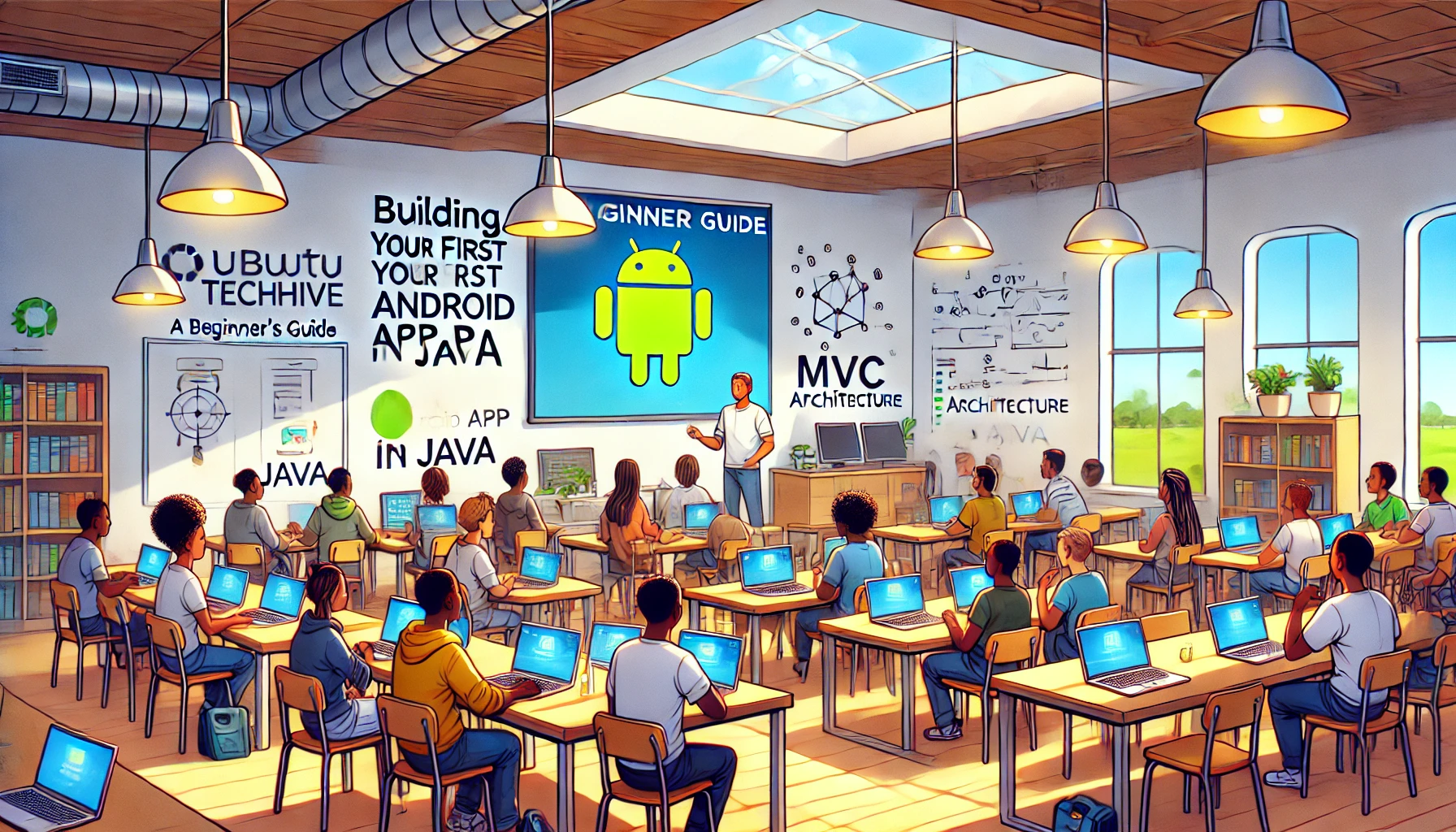
🚀 Join us for an exciting Ubuntu TechHive meetup where we'll delve into building your first Android app in Java! Whether you're new to the field or looking to expand your knowledge, this beginner-friendly session is designed to walk you through the process step by step. 🎯 **Agenda**: - **Introduction**: Get acquainted with the basics of Android app development. - **UI Design**: Learn about designing user interfaces using XML and Material Design principles. - **Model View Controller (MVC)**: Understand the MVC architecture and its application in Android development. - **Java and OOP**: Explore Java programming and Object-Oriented Design concepts. - **APIs and REST**: Discover how to integrate REST APIs into your Android app. - **Data Storage**: Learn about Shared Preferences and SQLite for data storage. - **Testing and Debugging**: Get tips on testing and debugging your app using Android Emulator. - **Deployment**: Understand the process of building and deploying your app to the Google Play Store. 📍 **Who Should Attend?** - Beginners interested in Android app development. - Tech enthusiasts looking to expand their knowledge in mobile development and Java. 👋 We look forward to seeing you there and exploring the exciting world of Android app development together!

Atlanta, Georgia, USA · September 7, 2024 · 10:30 AM · EDT · 2 hours

PastThe Ubuntu TechHive Online

Building your first Android App in Java

🚀 Join us for an exciting Ubuntu TechHive meetup where we'll delve into building your first Android app in Java! Whether you're new to the field or looking to expand your knowledge, this beginner-friendly session is designed to walk you through the process step by step. 🎯 **Agenda**: - **Introduction**: Get acquainted with the basics of Android app development. - **UI Design**: Learn about designing user interfaces using XML and Material Design principles. - **Model View Controller (MVC)**: Understand the MVC architecture and its application in Android development. - **Java and OOP**: Explore Java programming and Object-Oriented Design concepts. - **APIs and REST**: Discover how to integrate REST APIs into your Android app. - **Data Storage**: Learn about Shared Preferences and SQLite for data storage. - **Testing and Debugging**: Get tips on testing and debugging your app using Android Emulator. - **Deployment**: Understand the process of building and deploying your app to the Google Play Store. 📍 **Who Should Attend?** - Beginners interested in Android app development. - Tech enthusiasts looking to expand their knowledge in mobile development and Java. 👋 We look forward to seeing you there and exploring the exciting world of Android app development together!

Abidjan, Côte d'Ivoire · September 7, 2024 · 10:30 AM · EDT · 2 hours