Ubuntu TechHive

// events

Tech Events & Workshops

Discover and join virtual tech events, workshops, and meetups from the Ubuntu community worldwide. Connect with developers, engineers, and tech enthusiasts.

0

Today

0

Upcoming

5

Virtual

5

Total

PastThe Ubuntu TechHive Online

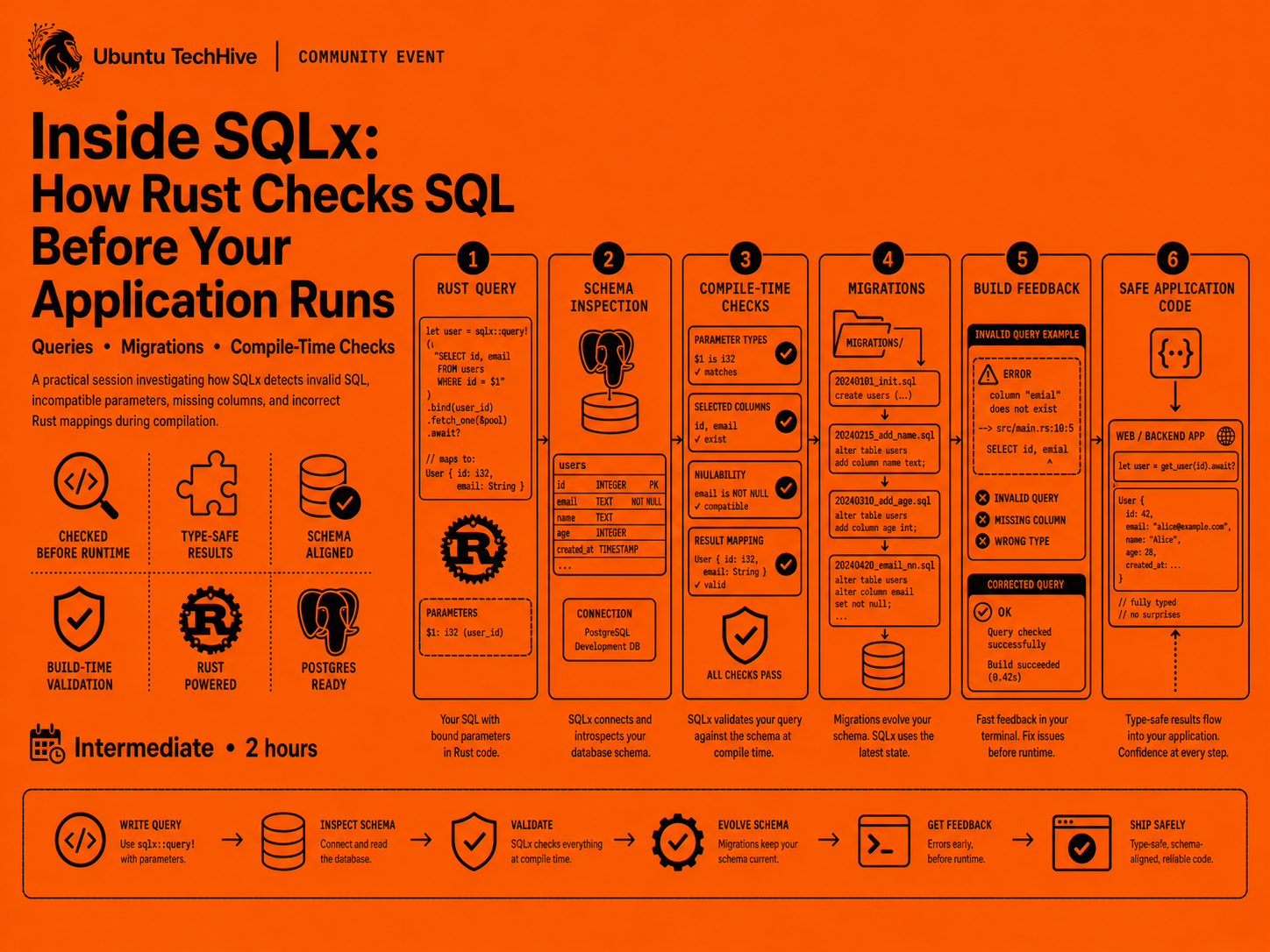
Inside SQLx: How Rust Checks SQL Before Your Application Runs

A practical two-hour session investigating how SQLx can detect invalid SQL, incompatible parameters, missing columns, and incorrect Rust mappings during compilation rather than after deployment. The session follows a query through the boundary between Rust and the database: from the SQL text and bound parameters, through schema inspection and type analysis, to the Rust value returned to the application. We will deliberately break queries, change schemas, and introduce type mismatches to understand what SQLx can prove before runtime—and what it cannot. The emphasis is not on memorizing an API. It is on understanding the engineering model behind compile-time checked SQL, the role of migrations in preserving that model, and the practical consequences for local development, testing, continuous integration, and deployment. Audience: developers who want to understand how Rust can provide stronger guarantees around ordinary SQL without replacing SQL with an ORM or query language. Outcomes: * Trace how SQLx validates a query during compilation * Understand how database metadata informs Rust type checking * See compile-time failures caused by invalid queries and incompatible result types * Understand why the current schema matters during a build * Connect database migrations to query correctness * Distinguish checked macros from runtime query APIs * Evaluate when compile-time SQL checking improves a project and when it adds friction Format: two hours with a guided investigation, broken-query experiments, migration examples, discussion of operational tradeoffs, and a reusable checklist for database code.

Abidjan, Côte d'Ivoire · July 25, 2026 · 10:30 AM · EDT · 2 hours
PastThe Ubuntu TechHive Online

Building Document Question-Answering Systems with Rust

A practical two-hour session on the principles behind document question-answering systems, with Rust as the implementation context. The session focuses on how applications can answer questions from a known set of documents instead of relying only on what a language model already knows. We will cover the core workflow: loading documents, preparing them for search, finding relevant passages, passing useful context to a model, and producing answers that stay connected to the source material. The goal is to teach the engineering ideas behind RAG systems without turning the session into a product demo or an abstract AI lecture. The emphasis is on system boundaries, retrieval quality, answer grounding, error handling, and the practical decisions developers need to make when building document-aware applications. Audience: entry-level and intermediate developers who want a practical session on document search, retrieval, grounded generation, and Rust application design. Outcomes: * Understand how document-based question answering systems work * Explain the purpose of chunking, embeddings, retrieval, and context assembly * Design a simple retrieve-first, answer-second workflow * Use Rust to organize the main parts of a small RAG application * Recognize common causes of poor or unsupported answers * Apply basic techniques for improving retrieval and answer quality * Think about how to evaluate whether the system is actually useful Format: two hours with a short framing walkthrough, a concrete example, discussion of tradeoffs, and a closing checklist for practice.

Abidjan, Côte d'Ivoire · July 11, 2026 · 10:30 AM · EDT · 2 hours

PastThe Ubuntu TechHive Online

Rust Data Pipelines: From Files to Clean Databases and Web Dashboards

A practical two-hour session on building reliable data pipelines in Rust, starting from messy input files and ending with clean data that can be stored, queried, and visualized in a web application. The session combines Rust, Polars, command-line data workflows, and SQLx to show how a developer can take CSV or Parquet files, validate and transform the data, handle errors clearly, persist clean records into a database, and prepare the results for charts, dashboards, or reporting screens. Rust is used as the implementation context, but the main lesson stays focused on software engineering fundamentals: data contracts, repeatable workflows, visible progress, reliable error handling, database migrations, compile-time query checks, and operational clarity. Audience: entry-level and intermediate developers who want a practical engineering session on turning raw files into clean, queryable, visualizable data. Outcomes: * Build a Rust command-line workflow that accepts input files and produces structured outputs * Clean and validate CSV or Parquet data before storing it * Use Polars for filtering, selecting, joining, grouping, and lazy execution * Store clean records in a database with SQLx * Use migrations and compile-time checks to make database access safer * Prepare stored data for visualization in a web application Format: two hours with a short framing walkthrough, a concrete end-to-end example, discussion of tradeoffs, and a closing checklist for practice.

Abidjan, Côte d'Ivoire · June 27, 2026 · 2:30 AM · UTC · 2 hours

PastThe Ubuntu TechHive Online

Rust Data Processing with Polars: CSV, Parquet, Joins, and Lazy Queries

A practical two-hour session on Rust Data Processing with Polars, focused on CSV, Parquet, Joins, and Lazy Queries. Rust is used as the implementation context while the core lesson stays on software engineering fundamentals, reliability, testing, and operational clarity. Audience: entry-level and intermediate developers who want a practical engineering session, not a language tour. Outcomes: - Explain the practical boundaries of Rust Data Processing with Polars - Apply CSV in a small working example - Apply Parquet in a small working example - Apply Joins in a small working example Format: two hours with a short framing walkthrough, a concrete example, discussion of tradeoffs, and a closing checklist for practice.

Abidjan, Côte d'Ivoire · June 13, 2026 · 2:30 PM · UTC · 2 hours

PastThe Ubuntu TechHive Online

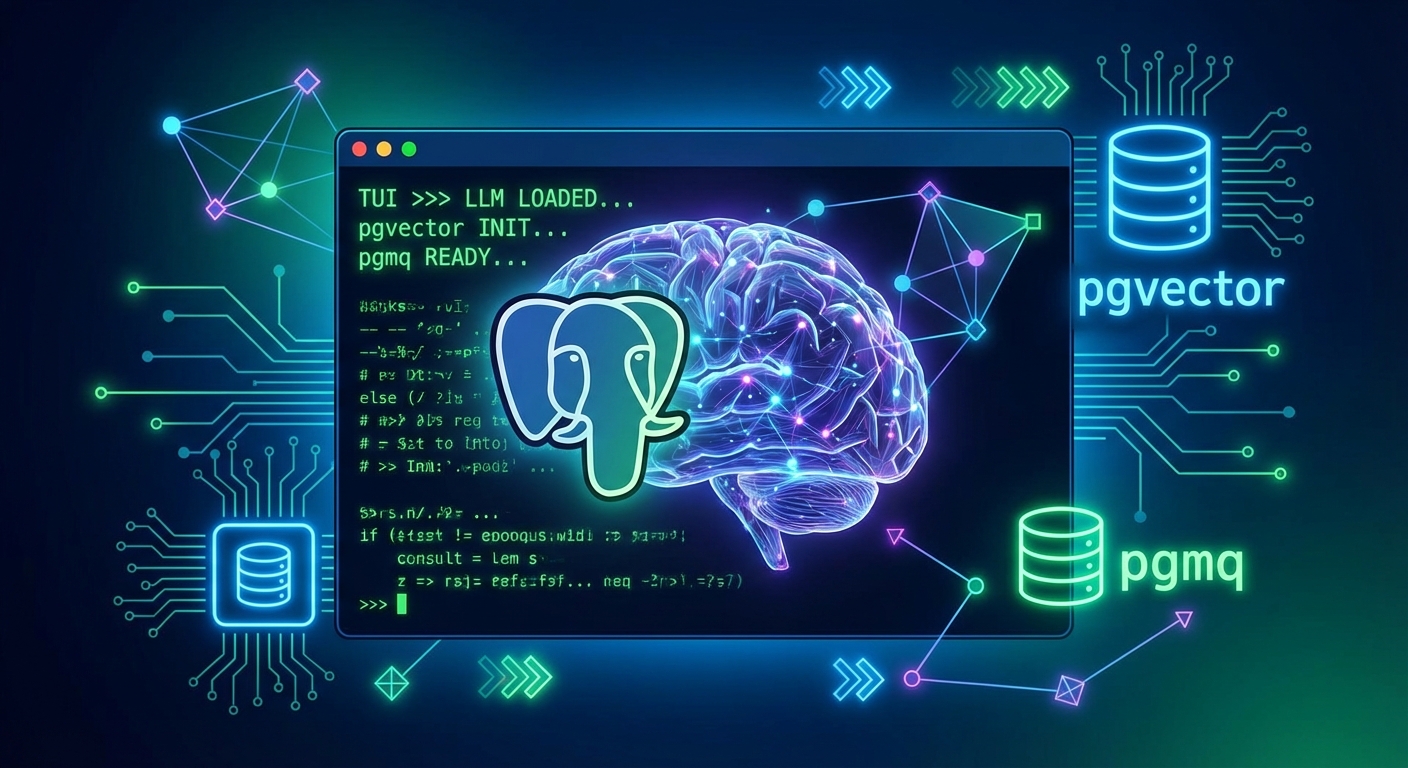
💻 Terminal Intelligence: Building AI-Powered Apps with PostgreSQL

Join us for an exciting hands-on workshop where Terminal User Interface (TUI) meets Artificial Intelligence! 🤖✨ What You'll Learn: 🐘 PostgreSQL Extensions for AI: Explore the **pgvector** and **pgmq** extensions 📝 Build a Smart Notes App: Create a TUI application with AI-powered features 🧠 Vector Databases in Action: Implement semantic search and retrieval-augmented generation (RAG) ⚡ Durable Code Execution: Learn how PostgreSQL can handle AI workflows 🔍 Modern AI Features: Experience how traditional databases can power cutting-edge AI applications Session Flow: Setup Phase: Configure PostgreSQL with AI extensions Implementation Phase: Build the TUI Notes App step-by-step AI Integration: Add intelligent features and see them in action Exploration: Push the boundaries and see how far we can go! Perfect for developers interested in database-driven AI, terminal applications, and practical machine learning implementations. No matter your experience level, you'll walk away with hands-on knowledge and a working application! 💪 📅 When: December 13, 2025 at 10:30 AM ET ⏰ Duration: 2 hours of intensive learning 🎯 Format: Interactive workshop with live coding Ready to explore the intersection of databases and AI? Let's build something amazing together! 🌟 Connect with our community: * 💬 **Discord**: https://discord.gg/48dVXMenP9 * 📱 **WhatsApp**: https://chat.whatsapp.com/Ic2PPvxzy8KCkB8Ww5kR39 * 💼 **LinkedIn**: https://www.linkedin.com/showcase/the-ubuntu-techhive * 🌐 **Website**: https://ubuntuhive.tech

Abidjan, Côte d'Ivoire · December 13, 2025 · 2:30 PM · UTC · 2 hours